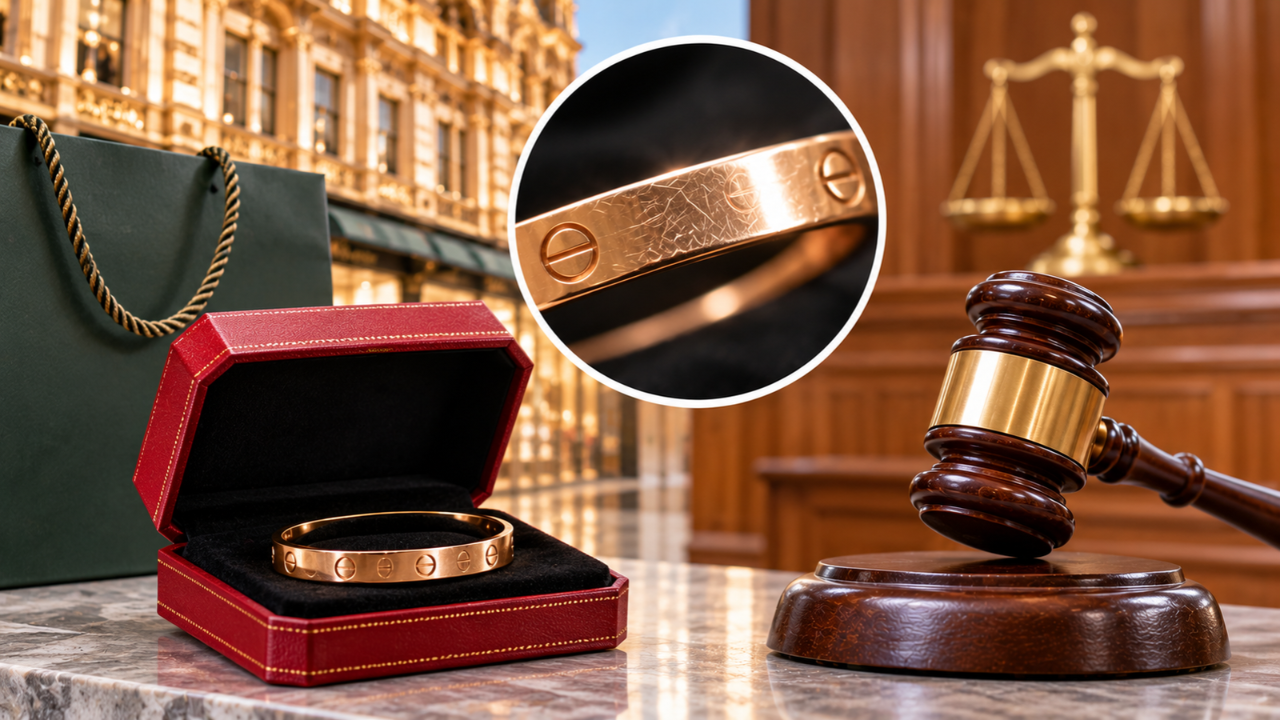
A £4,550 Bracelet, a Disputed Video, and a Courtroom Reality Check
Luxury retail runs on polish, prestige, and strict return rules. Yet when a customer pushes back with hard facts instead of polite frustration, that polish can crack fast.
Georgia Romain, a hypnotherapist from Kingston upon Thames, saved up for years to buy herself a £4,550 Cartier bracelet from Harrods as a birthday gift. When the 18-carat gold piece turned out to be too small for her wrist, she sent it back expecting a refund. Instead, Harrods rejected the return over alleged scratches, claimed the bracelet couldn't be resold, told her it was legally her property, and warned it would move to lost property if she didn't reclaim it within 30 days.
She didn't walk away. Representing herself in court, Romain won £5,131—covering the £4,550 purchase price plus interest and court fees—after Deputy District Judge Elaine Vignoli ruled that Harrods hadn't proven on the balance of probabilities that the bracelet was returned scratched.
Here's the takeaway for anyone buying high-ticket items online or from a distance: a retailer saying a luxury item is damaged isn't the same as proving it in court. Under UK distance-selling rules, a seller can deduct money if a customer handles goods beyond what's needed to inspect them and reduces their value, but the retailer has to back up its claim with solid evidence.
How the Cartier Refund Dispute Unravelled
On paper, returning an unworn piece of jewellery that doesn't fit sounds straightforward. In practice, high-value returns often trigger intense scrutiny because soft precious metals like 18-carat gold can pick up micro-scuffs easily, and luxury houses guard resale standards fiercely.
According to court reporting from The Independent, Harrods' customer service team recorded a "pre-inspection video" after receiving the bracelet and pointed to scratches and defects as the reason for refusing the refund. That video was meant to settle the matter. Instead, it gave Romain her strongest opening.
When she reviewed the footage in August 2025, she spotted two glaring gaps:
- No visible serial number: Romain asked how she could be sure the bracelet on camera was actually the one she'd bought if the footage didn't show its unique serial number.
- Different appearance: She challenged Harrods because the bracelet held up in the video looked thicker than the one she had ordered.
Harrods didn't answer those points directly in its follow-up response. Instead, it stood by its formal rejection and told her the item was legally hers. For a buyer who had saved for years and was left out both the money and a usable refund, that response turned a sizing problem into a full-blown legal dispute at Mayor's and City County Court.
Why the Judge Ruled Against Harrods
Civil claims in England and Wales are decided on the balance of probabilities—meaning what is more likely than not based on the evidence presented. Harrods' legal team argued the bracelet had been handled carefully and secured safely along the way.
Deputy District Judge Elaine Vignoli wasn't convinced. She noted there was a lack of evidence before the court showing the bracelet had the same scratches at the moment Harrods received it from Romain. Without a clear chain of proof linking the alleged damage to Romain's return rather than handling or inspection afterwards, the defence fell short.
The judge also pushed back on the idea that minor scuffs or scratches had wiped out the bracelet's value. Harrods argued it couldn't resell the piece because of its condition, yet hadn't provided strong evidence showing how the alleged defects reduced its value. As Judge Vignoli pointed out in court, if a luxury 18-carat gold Cartier bracelet were genuinely worthless, she'd happily take it home herself—calling it a "rather pretty, luxurious item."
Honestly, that line cuts right to the heart of luxury retail disputes. Retailers sometimes treat "not fresh enough for our display counter" as if it means "worthless," and courts don't automatically buy that leap.
What UK Law Actually Says About Luxury Returns and Scratches
People often confuse store goodwill policies with statutory consumer rights. They aren't the same thing, especially when you buy online or by phone rather than walking into a shop.
Under the Consumer Contracts (Information, Cancellation and Additional Payments) Regulations 2013, distance shoppers generally have a 14-day cooling-off period after receiving goods to cancel for any reason, followed by 14 days to send the items back. Crucially, the law lets you inspect goods much like you would in a physical store to check their nature, characteristics, and functioning.
However, if you handle an item more than necessary to inspect it and that handling reduces its value, the trader can make a proportionate deduction from your refund—provided they can justify it. Guidance from Citizens Advice also reminds shoppers that small claims courts in England and Wales handle straightforward money claims (generally up to £10,000) and are designed so everyday people can bring a case without hiring a solicitor.
Common Mistakes Buyers Make in High-Value Disputes
Having dealt with consumer complaints and seen how disputes play out, I've noticed that shoppers with strong rights still lose leverage when they skip basic documentation. Here are the traps that trip buyers up most often:
- Skipping timestamped photos and video before shipping: If you send back an expensive watch, ring, or bracelet without clear close-ups taken right before packing, it becomes your word against the seller's warehouse or inspection team.
- Relying on vague phone calls: Verbal promises from customer support are hard to prove later. Keep every dispute in writing—email or recorded chat transcripts—so you have a clean timeline.
- Treating every rejected return as hopeless: Retailers frequently push back hard on high-ticket items. A firm, evidence-backed letter before action or a small claim often forces a closer look, especially when the seller's own proof has holes.
- Ignoring the cost-benefit math: Court fees apply when you file a claim (though successful claimants often recover fees, and help with fees exists for eligible low-income applicants). For a £4,550 bracelet, pursuing a claim makes far more sense than for a £25 item.
What Remains Unclear About the Case
Fairness matters when reporting on court disputes, and there are limits to what public court accounts show. Public reports of the hearing focus on the evidence presented to the judge and don't lay out every internal warehouse step Harrods took or every detail of how the bracelet was packaged on return. Nor does a single county court ruling change the law across the board—every case turns on its own facts, witness or documentary evidence, and contract terms.
What this ruling does show is that brand prestige doesn't give a retailer a free pass on proof. If a store claims your returned luxury piece arrived scratched and unsellable, the judge is going to look at the evidence, not just the logo on the box.
Practical Next Steps If a Retailer Refuses Your Refund
If you ever find yourself staring at a refund rejection over alleged damage or wear, don't just vent on social media and give up. Take methodical steps:
- Demand the exact proof in writing: Ask for clear photos or video of the alleged damage, confirmation of serial numbers or identifying marks, and an explanation of how the issue affected the item's value.
- Gather your own record: Pull together your order confirmation, dispatch and delivery tracking, packaging details, and any photos or video you took before sending the item back.
- Escalate formally and check consumer guidance: Send a clear written complaint setting out the facts and timeline, and review official guidance from GOV.UK consumer protection resources or Citizens Advice before deciding whether to send a letter before claim or file in small claims court.