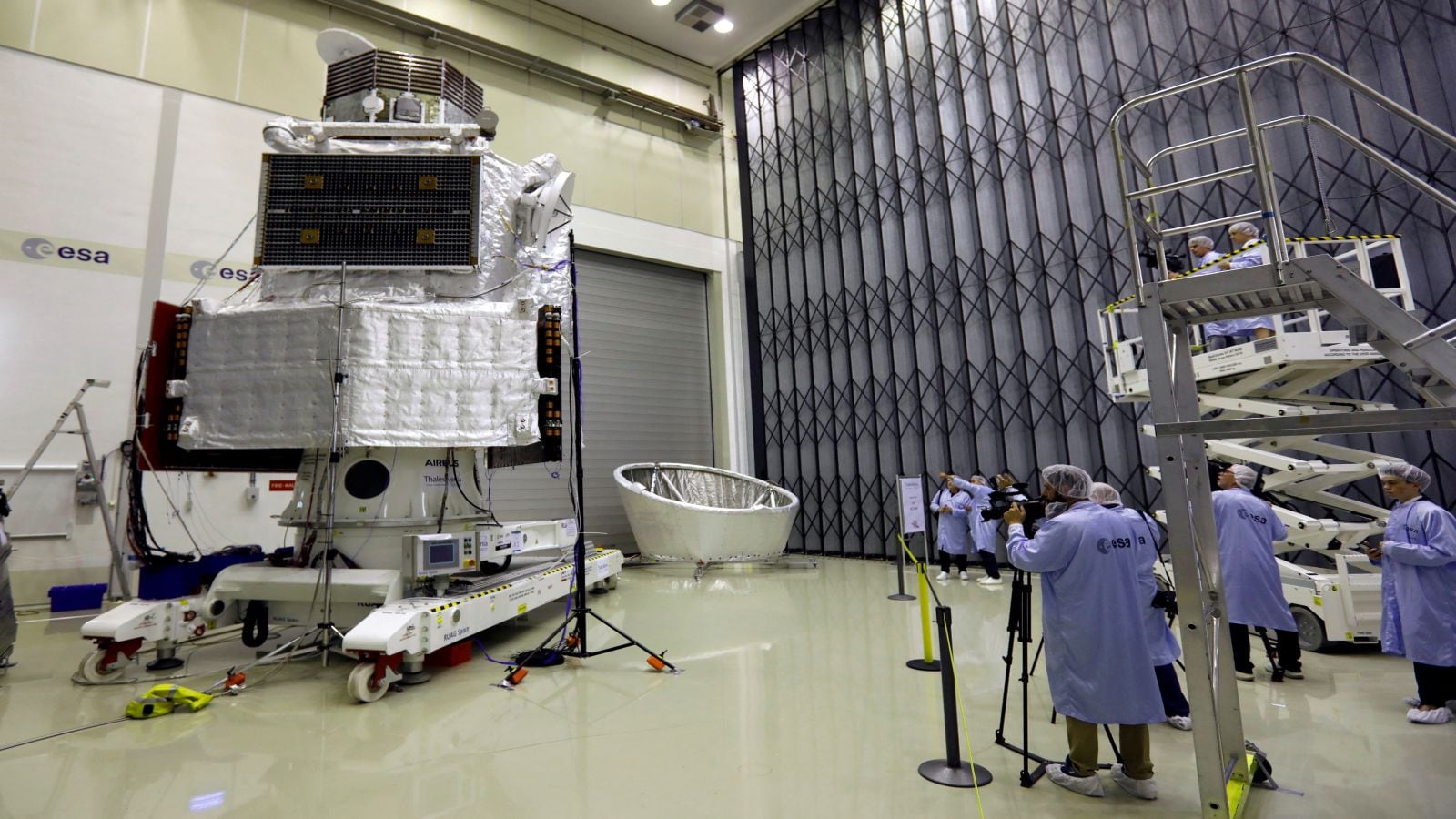
BepiColombo finally made it into orbit around Mercury on November 21, 2026, right on the scheduled capture date after more than eight years in space. Then, a day later, the European Space Agency dropped a quieter twist: the thruster burn during orbital insertion ran shorter than planned because of a software issue.
Spacecraft is safe. Teams at ESOC are digging into the telemetry. That's the headline reality right now.
If you've watched this joint mission from the European Space Agency and the Japan Aerospace Exploration Agency since its October 20, 2018 launch from Kourou, you know nothing about getting to Mercury is simple. Breaking news summaries treat a shorter burn like a five-alarm fire, while press releases sometimes smooth over the rough edges. Honestly, neither reaction tells the full story. Capture succeeded, which means the spacecraft is bound to Mercury rather than flying past it, yet every short burn or software hiccup in deep space deserves a closer look because fuel margins and orbital timing aren't infinite.
What Happened During Mercury Orbit Insertion
BepiColombo reached Mercury capture on November 21, 2026, after shedding eight years of orbital energy through one Earth flyby, two Venus flybys, and six Mercury flybys. Once the Mercury Transfer Module separated on September 3, 2026, steering and braking fell to the chemical thrusters on ESA's Mercury Planetary Orbiter. To understand the complete picture, check out the excellent article by Mashable.
According to ESA's official BepiColombo arrival updates, the mission team spent months running intense arrival simulations between June and late October 2026. Controllers practiced handling unexpected anomalies while actively flying the spacecraft—a notoriously tricky juggling act because you can't pause real flight operations to run a dress rehearsal.
When the orbital insertion burn happened, the engine cut short due to a software issue. Even so, capture into Mercury orbit held. That distinction matters. A missed burn could have sent the stacked spacecraft skimming past the planet or into a wayward trajectory. A shorter burn still achieved capture, though engineers at ESA's European Space Operations Centre (ESOC) now have to verify exact orbit parameters, check how much delta-v remains, and adjust upcoming maneuvers if needed.
This Isn't the First Hiccup on the Road to Mercury
If you're surprised that a software snag popped up at the finish line, you haven't been paying close attention to BepiColombo's flight log. Getting to the innermost planet has been a long string of workarounds.
Back in April and May 2024, ESA ran into a power-related anomaly involving unexpected currents between the solar array and the power unit. That shortfall kept the solar electric propulsion system from running at full thrust. Instead of forcing a risky push, mission planners redesigned the trajectory in September 2024, moving Mercury arrival from December 2025 to November 2026.
That delay followed earlier schedule shifts on the ground during development of the electric propulsion system. In spaceflight, long cruise phases are like long road trips on a vintage car. Parts age. Thermal swings—intense solar heat on one side, freezing shadow on the other—test every connector, sensor, and line of flight code. A software glitch during orbital capture is frustrating, sure, yet it's almost routine in the broader context of an eight-year inner-Solar-System trek.
Why Mercury Is So Brutally Hard to Reach
People hear "closest planet to the Sun" and assume you just point a rocket inward and go. Doesn't work that way.
To drop from Earth's orbit down to Mercury without burning an impossible amount of propellant, a spacecraft has to fight the Sun's deep gravity well. As you fall inward toward the Sun, you pick up speed. If you arrive going too fast, you whip right past Mercury instead of getting captured into orbit.
That's why BepiColombo relied on gravity assists and low-thrust ion propulsion for years before switching to MPO's chemical thrusters for arrival. Even NASA's MESSENGER mission, which became the first spacecraft to orbit Mercury and ended its run by impacting the surface in 2015, required years of intricate orbital mechanics to slow down enough for capture.
Look at the terrain in that view of Mercury. It looks calm in a photograph, almost quiet, yet it sits in one of the harshest radiation and thermal environments in the Solar System. Baking sunlight on sunward surfaces can push temperatures past 400 degrees Celsius in Mercury's harsh environment, while shadowed polar craters stay permanently cold enough to trap water ice.
Two Orbiters, Two Very Different Jobs
One thing short news briefs almost always gloss over is that BepiColombo isn't just one probe. It's a pair of complementary spacecraft built for different parts of the puzzle.
ESA's Mercury Planetary Orbiter carries eleven science instruments aimed downward at the planet itself. It's built to map surface geology, measure composition, probe Mercury's massive iron core, and study its internal structure. Before orbital insertion, teams ran "first light" and health checks on instruments like the BELA laser altimeter, the MERTIS thermal imaging spectrometer, and the SIMBIO-SYS camera system after the transfer module separated.
JAXA's Mercury Magnetospheric Orbiter, named Mio, focuses on the space environment around Mercury—its magnetic field, plasma, and how the solar wind batters a small world that lacks a thick atmosphere to shield it. Mio is designed to spin at 15 rotations per minute once released into its own polar orbit.
Right now, the two orbiters are still stacked together, with Mio protected by its sunshield and interface structure (MOSIF). Separation isn't a single switch flip. Current ESA timelines put Mio's release into its elliptical polar orbit around December 9 to 10, 2026, followed by MOSIF release around December 16, 2026. MPO then uses its own thrusters to step down toward its target science orbit around March 10, 2027, with full science operations slated to begin around April 6, 2027.
Notice those dates. Every one of them is an operational milestone, not a carved-in-stone guarantee. When a thruster burn cuts short during capture, flight dynamics teams have to check how that affects downstream burns and separation windows.
Common Misconceptions About This Milestone
- The glitch means the mission failed. Not true. ESA confirmed BepiColombo was captured into Mercury orbit and remains safe. Anomalies during major burns happen; what counts is whether the orbit is recoverable and safe.
- Science data starts tomorrow. Also not true. Capture is just the entry ticket. Separating Mio, jettisoning MOSIF, maneuvering MPO into its tighter science orbit, and calibrating instruments take months, pushing nominal science observations into spring 2027.
- BepiColombo is the first spacecraft to orbit Mercury. Wrong. NASA's MESSENGER entered Mercury orbit in 2011 and operated until 2015. BepiColombo is the second to enter orbit around Mercury, and the first to do so with two spacecraft working together from distinct orbits.
Practical Next Steps If You're Following the Mission
- Track primary mission logs instead of recycled headlines. Check ESA's BepiColombo arrival updates and official mission feeds from ESA and JAXA for updates on the ESOC software investigation and post-capture orbit checks.
- Watch the December 2026 separation window. Keep an eye on December 9–10 for Mio's planned release and December 16 for MOSIF release, since those steps untangle the stack and set up each orbiter's independent path.
- Compare early MPO and Mio findings once science begins in 2027. Pay attention to how surface and interior measurements from MPO pair with magnetic and solar-wind data from Mio—that dual-vantage pairing is the whole reason two orbiters flew together.
- Treat early post-burn numbers as preliminary. Right after an anomalous burn, engineers prioritize spacecraft health and orbit determination first, so exact updated timelines can shift before final science orbits are locked in.